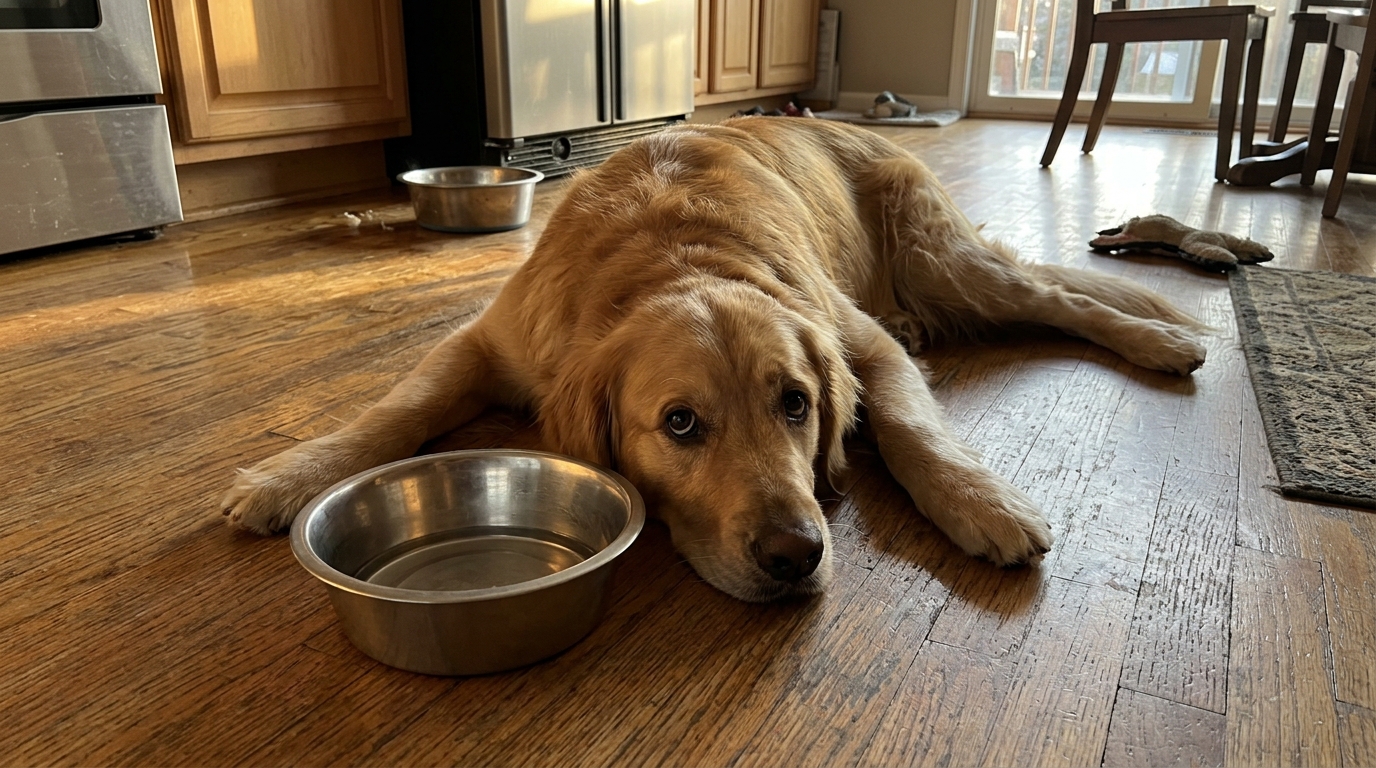
It's 11 PM. Your dog is lying next to their bowl, staring at you like you personally betrayed them. You reduced their food by a tiny amount. They're acting like you've canceled dinner forever.
If this feels familiar, you're not alone. Search interest in "dog weight loss" and "dog diet" is climbing, and the numbers back it up: roughly half to 60% of dogs worldwide are overweight or obese [citation:1][citation:5]. The struggle is real. And it's everywhere.
Your vet said "chunky." You felt a little offended on your dog's behalf. But here's the thing: they're not wrong. And the fix isn't as brutal as your dog wants you to believe.
Why the drama?
Dogs don't understand calories. They understand "food was here, now food is less." To them, a smaller portion isn't a health plan. It's a crisis. And those big eyes? They're evolutionary weapons designed specifically to break you.
But here's what actually matters: even a few extra pounds puts real stress on joints, hearts, and organs. Overweight dogs are at higher risk for arthritis, breathing issues, and a shorter, less comfortable life [citation:6]. The goal isn't a hungry, miserable dog. It's a dog who moves easier, plays longer, and doesn't huff on the morning walk.
A slightly smaller bowl now means more pain-free walks later.
First, figure out if your dog is actually "chunky"
Vets use something called a Body Condition Score. It's a 1-to-9 scale, where 4 or 5 is ideal [citation:9][citation:16]. You can do a rough check at home right now.
Run your hands along your dog's ribs. You should feel them easily under a thin layer of fat—like the back of your hand. If you have to press hard, or if you can't feel them at all, your dog is carrying extra weight [citation:16].
Look from above. Is there a waist? Look from the side. Is there a tuck where the belly meets the back legs? If the answer to either is "not really," it's time to make a plan.
The diet part (without the misery)
Here's what actually works, according to vet nutritionists and the people who study this stuff for a living.
1. Measure. Don't guess.
Use a real measuring cup or, even better, a kitchen scale. "Eyeballing it" is how portions creep up. Feed for your dog's ideal weight, not their current weight [citation:3]. If your vet says your Lab should be 70 pounds and she's currently 85, you're feeding for 70.
2. Treats count. Sorry.
Treats should make up no more than 10% of your dog's daily calories [citation:9]. A "small" biscuit can be a significant chunk of a small dog's daily intake. Swap some treats for green beans, carrots, or a piece of their own kibble [citation:3]. Your dog will complain. Your dog will survive.
3. Make them work for it.
Scatter feeding or puzzle toys slow eating down and add mental stimulation. A dog who had to "hunt" for their dinner feels more satisfied than one who inhaled it from a bowl in twelve seconds [citation:3].
4. Consider a vet-recommended food.
This is the part people skip. Regular "lite" kibble from the pet store isn't formulated for actual weight loss. Veterinary weight-loss diets are designed with higher protein and fiber to keep your dog full while calories drop [citation:5]. Ask your vet if it's worth the switch.
Your dog isn't starving. They're negotiating. Don't fall for it.
Movement matters, but not the way you think
You don't need to run your dog into the ground. In fact, if your dog is significantly overweight, intense exercise can stress joints that are already working overtime.
Start with longer sniff walks. Sniffing burns brain energy without the physical strain. Add in short play sessions—fetch, tug, a little chase around the yard. Build up gradually as the weight comes off [citation:3].
And here's a bonus: the more weight they lose, the more they'll want to move. It's a loop. You just have to start it.
What NOT to do
- Don't starve them into shape. Rapid weight loss is dangerous and can cause muscle loss. Aim for 1-2% of body weight per week [citation:11]. Slow and steady.
- Don't cave at the sad eyes. You're not being mean. You're being a good owner. There's a difference.
- Don't forget the other humans in the house. If your partner, kids, or roommate is sneaking treats, your dog isn't actually on a diet. Everyone has to be in on the plan [citation:11].
- Don't skip the vet visit. Rule out medical causes first. Thyroid issues and other conditions can make weight loss nearly impossible without treatment [citation:3].
The part nobody tells you
Your dog is going to act like you've committed a crime. They're going to sigh dramatically. They're going to lie by the bowl and look at you like you've forgotten everything you ever knew about love.
Ignore it. Or at least, don't let it change the portion size.
The truth is, the most loving thing you can do for a chunky dog is the uncomfortable thing. The measured cup. The skipped table scrap. The walk when it's drizzling and you'd rather not.
Your dog doesn't need an apology for the smaller dinner. They need you to stay strong for about eight weeks.
Because on the other side of those eight weeks? A dog who jumps into the car without help. Who does the zoomies without hacking. Who makes it up the stairs without that little pause halfway.
That's the dog you're actually feeding. The one who'll be around longer because you didn't give in to the eyes.
You've got this. Even when your dog says you don't.
